Pages

Friday, 16 December 2016

Bijoli Grill

Debu Barick and his uncle started small eatery, named "Dipti Cabin" and next changed to Bijoli Grill in 1947, behind Bijoli Cinema in Bhowanipore.

The students of Asutosh College and the like would frequent for endless cups of tea, lip smoking snacks and most important... long sessions "adda" customers were mostly students and young people, dreams in their eyes, poetry books in their pockets and loads and loads of topics for continued discussions accompanied by tea at 3 paise and toast at 4 paise. Dibyendu Palit, Manas Roychoudhry, Somnath Bhattacharya, Ajoy Roychoudhury ... all renowned later for their contributions in the field of literature, education and medicine ... coming to Bijoli Grill for their quota of "adda", literary discussions and the customary cups of Debu Barick’s tea.

Bijoli Grill became a formidable brand in food and catering to some of the most recalled celebrities by now ... Indira Gandhi, Rajiv Gandhi, Zakir Hussain, Jyoti Basu, Mithun Charaborty, Aparna Sen, the Indian and West Indies Cricket team ... the list is endless. Bijoli Grill today caters simultaneously to 22-25 marriages in an evening.

                                                                                              --Sudipta Bhowmick

Babu s of Kolkata (THE MULLICKS OF BURRABAZAR)


Imagine a carriage pulled by a pair of Zebras.Manmathanath Mullick, bought a pair of zebras from Alipore Zoological Gardens to pull his carriage through the streets of Kolkata. He had nine types of carriages and a stable full of horses. One of the grandsons of Jadulal Mullick, Prodyunno Kumar Mullick had 35 cars, out of which 10 were Rolls Royce. Next to the turrets of Tagore Castle on Prasanna Kumar Tagore Street is the house of the Mullick family topped by classical statuary.


--Swarnali Chattopadhya

Thursday, 15 December 2016

Calcutta: dazzling


It isn’t like one of those cities, Calcutta: dazzling, shocking, astonishing. Sandip Ray said in one of the sessions in the literary meet this year, “Calcutta is about having dinner at home”. It won’t shock you with the power it has over you, over your life. It will not damage you with its claims of money and power. Calcutta will get into you. It will become a chunk of your heart, a loss in your memory. It will confuse you every time you call it Calcutta and some stranger from far away asks you, “Isn’t it called Kolkata now?” But is it?

I remember when the first mall in Kolkata, Forum, opened. I remember how I would be so excited to go watch a movie there and then puppy-eye Baba into buying me ice cream from Baskin Robins. Today, Baba and I don’t really go to that many movies together and malls seem to be plain boring. Calcutta was in Baba buying me ice cream. Calcutta is in New Market. Kolkata is an illusion.

Calcutta is the way you can just stop while walking on the road and wonder if you really want to go where you are going. It is giving up your seat in the bus for the old widow with broken spectacles and a faded, bordered, white saree who will say “Na ma, tumi bosho” with her crinkled, wrinkled smile. Calcutta is the way all the buses stop at the wave of a hand and conductors yell, “Aaste! Ladies pete bachha!”, all those rickshaw wallahs and the trams that are too slow for Kolkata but perhaps just fast enough for Calcutta. It is in eating jhaal muri after shopping at Vardaan Market, buying a chocolate softy outside Treasure Island after a satisfying day spent at New market. It is in leaving office early to go to Victoria just because you suddenly felt like it. It is in all those ideas that won’t seep into words and then all those silences, which would be crippled by a search for meaning. Calcutta is in the conviction with which you will reply after a pause, “No, it will always be Calcutta to me.”

Calcutta isn’t like the other cities. It isn’t an addiction. It won’t haunt when you are gone. It will calm your nightmares. There might be a day when you will feel like leaving it, leaving behind your daaknaam, to go away to where you could do something more with your life because really, Calcutta seems to be forever in a dream, cut off from the pace of other cities, giving its people a pause, a moment to bring back hope. Time is irrelevant to it, an insignificant formality to define life with.

You know how all through our lives we keep moving to bigger, better houses? Calcutta is the first house you ever knew, the one that had practically no furniture and patches of paint would keep falling off and yet it was home. Calcutta is peeping behind the walls of that house playing hide and seek with your first friend ever. And when you are long gone, a resident of some bigger, better city and are standing in a shop buying a cigarette, it will come to you in the memory of your boyfriend back home asking you to quit. That’s what Calcutta does to you. It gets into you. In the way you will order dinner at the last minute even though you aren’t hungry as such because you remember Ma asking you to eat properly with tears in her eyes when you were leaving and the bag full of food she manipulated you into carrying.

But mostly, Calcutta will teach you to be in love. Your first dream, your first crush, the way you would hide being in love like you were 5 and it was a chocolate you didn’t want to share. It will teach you to love faces and places and then it will teach you to love life, just as it is. It will teach you that this is it, that no matter what you get from life now, will not be greater than this gift of being in love, knowing that you would give everything, every inch of your universe for one thing. And you will ask yourself on some days, in between cups of cha, if it’s all that mattered. Isn’t there supposed to be more to life? But is there?

Calcutta may try to become Kolkata, try to fit in but perhaps, it never will. It will always be the sunlight seeping in through the leaves of trees, the stars that you will pack in your bags when you leave. It will always be Calcutta in the song on its roads, in the dance of Durga Puja, in the way you will love and let go, and love again

--Seema Bhattacharya

Wednesday, 14 December 2016

Rickshaws of Kolkata

Originally brought to India by Chinese immigrants, rickshaws were a major technological advance over the sedan chair, or palanquin, found in 19th century Europe and Asia. Invented in Japan in the 1860s, the jin riki sha required only one puller, compared with the two to four footmen required to carry a single person on a palanquin. Rickshaws became the favored form of transport for the middle and upper classes, not just in India, but across Europe as well. The most controversial cinema ‘City of Joy’ was based on the traumatized life of a rickshaw puller (cast by Om Puri) and his wife (cast by Shabana Azmi).

Like tea, tram, cricket and Gothic architecture, the hand-pulled rickshaw is a British heritage in Kolkata’s colonial treasure. The long parallel bars and colorful seats with the ‘tung tang’ rhythm of the bells, make Rickshaw an emblem of Kolkata.

--Debojit Bose

Monday, 12 December 2016

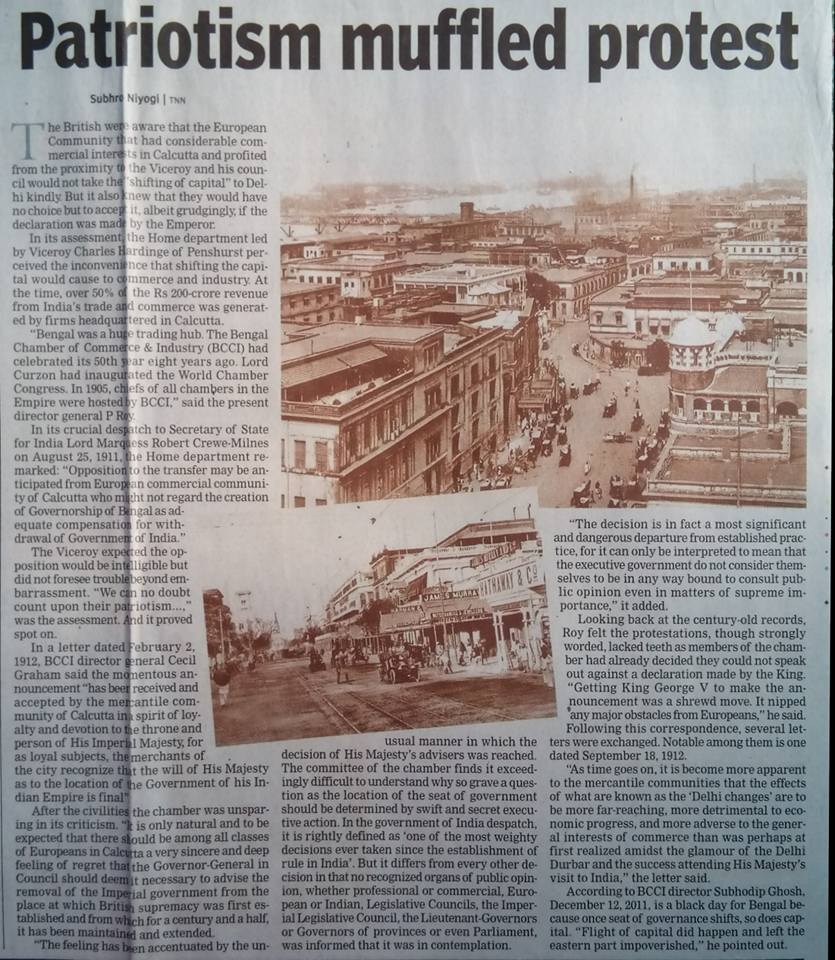
Shifting the Capital


Three and a half months. That's all it took the British govt 104 years ago to decide on shifting the capital.

In the year of 1911, December 12.

Picture Courtesy : Bourne & Shepherd

(TOI, 11/12/2011)


--Ellora Chatterjee

Monday, 15 August 2016

Maharaja Nandkumar


The apparent site of India's first judicial murder under the British East India Company, this place is located in Hastings.

It is the place where Maharaja Nandkumar, the Nawab-appointed Diwan of Hoogly,Nadia and Burdwan, was hanged till death for his "audacity" of accusing the first Governor-General of India, Warren Hastings, of bribery and corruption.

Maharaja Nandkumar, who was conferred the title of Maharaja by Shah Alam ll in 1764, was appointed the collector of taxes in the same year by the East India Company in place of Warren Hastings.

In 1773 after Hastings was reinstated as the Governor-General of India, the Maharaja brought the charges of corruption against him. Strangely, as the governor general of India and the head of the Supreme Council of Bengal, Hastings had the power of overruling the accusation which he did. He then brought charges of forgery against the Maharaja in 1775. Nandkumar was tried under British law even though he was an Indian. It seems that was the only way the Maharaja could be taught a lesson since conviction for forgery under British law meant capital punishment.

Maharaja was tried under Sir Elijah Impey, India's first Chief Justice of the Supreme Court of Calcutta and very conviniently,a school friend of Warren Hastings.

As is anybody's guess, the Maharaja was sentenced to death and was executed on 5th August,1775.


This is documented history.


However, the strangest thing is, no one knows for sure where he was hanged. Historians direct us towards a place in present day Hastings area, just opposite the Army Residential Complex near Khidderpore Bridge.


Out of curiosity and a sense of adventure, following old newspaper leads, I decided to visit the place which apparently the Maharaja,as a devout Hindu, had himself chosen so that he could face Adi Ganga when he was murdered.


What I saw was a shock that I am yet to recover from. Surrounded from all sides with tea shops, auto stands, curious bystanders with no work and a Ward office, the gallows has obvious popular political paint on it to match the outer wall and all the surrounding buildings.


The gallows looks like a deep well, filled with unimaginable filth since it seems to be a dumping ground for the localites who throw trash inside, answer their calls of nature inside giving rise to a horrible stench, dry their washed clothes and selectively,spend their nights.


But strangely, there is no epitaph, no claiming for sure that this is the gallows where the Maharaja was hanged. Although the well has a huge rotating iron lever whose presence is inexplicable other than being an object to be used to raise or remove a stage from under someone's feet to teach him a lesson.


On the 69th Anniversary of our Independence (although why we are celebrating it as the 70th is beyond me) I feel we have the right to know the truth and pay proper respect to the victim of India's first political murder under the British.


Jai Hind.


--Debjani Datta